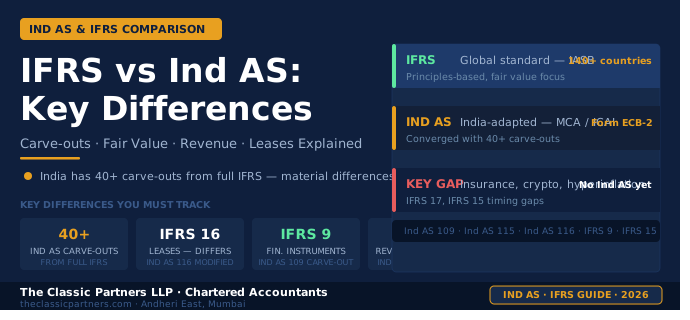
IFRS vs Ind AS: Key Differences Every Indian Business Must Know
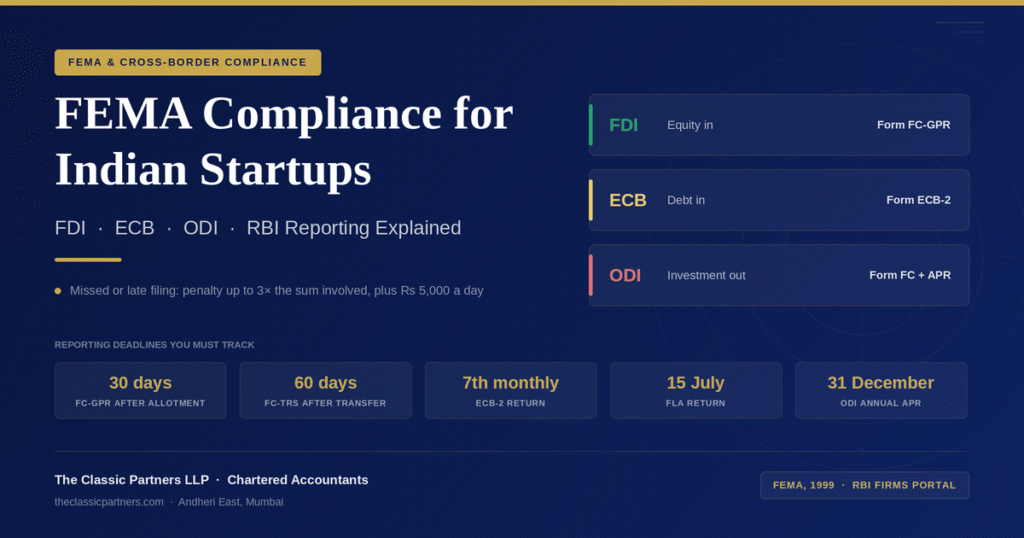
3× THE SUM MAX FEMA PENALTY FEMA COMPLIANCE FEMA Compliance for Startups FDI · ECB · ODI · RBI Reporting Explained 30 Days FC-GPR After Allotment 60 Days FC-TRS After Transfer 15 July FLA Return, Every Year THREE ROUTES, THREE REPORTING TRACKS FDI — Equity in → Form FC-GPR / FC-TRS ECB — Debt in → Form ECB + ECB-2 monthly ODI — Investment out → Form FC + Annual APR The Classic Partners LLP · Chartered Accountants theclassicpartners.com · Andheri East, Mumbai · August 2026 FEMA 1999 RBI FIRMS PORTAL FOREIGN EXCHANGE MANAGEMENT ACT, 1999 FEMA compliance for Indian startups means following the Foreign Exchange Management Act, 1999 whenever a business receives foreign investment, borrows from abroad, or invests overseas. Any startup that raises FDI, takes on ECB, or sets up an ODI structure must report the transaction to the RBI through a prescribed form, within a fixed deadline. Getting this wrong is not just paperwork trouble. Late or incorrect RBI reporting can trigger compounding penalties, stall a funding round during due diligence, and in some cases freeze the transaction until it is regularised. This guide breaks down FDI, ECB, ODI, and RBI reporting for Indian startups — the routes, the forms, and the deadlines you actually need to track. What Is FEMA and Why Does It Matter for Indian Startups? FEMA is the law that governs all cross-border money movement in and out of India, administered by the Reserve Bank of India. Every foreign investment into a startup, every overseas loan, and every rupee sent abroad for investment falls under it. FEMA compliance for Indian startups matters because: Penalties are statutory. Non-reporting or delayed reporting attracts penalties under Section 13 of FEMA, which can run into lakhs of rupees. Investors check the filings. Investors and acquirers review FEMA records during due diligence — gaps here can delay or kill a funding round. Banks stop the next transaction. Banks will not process further inward remittances or share allotments until pending FEMA filings are cleared. Nothing is valid until regularised. Non-compliant transactions must be regularised through RBI compounding before they can be treated as valid. What Are the FDI Rules Indian Startups Must Follow? Every cross-border rupee has a route, a form, and a deadline attached to it FDI compliance for startups India starts with knowing which route applies to your sector. Most startups fall under the Automatic Route, where no prior RBI or government approval is needed. Foreign direct investment compliance India-wide is sector-linked, not one uniform rule — the same investment amount can be automatic in one sector and need approval in another. Automatic Route — No Prior Approval Covers most sectors: IT, e-commerce marketplaces, most services, manufacturing Funds can be received first Reporting to the RBI follows the transaction FC-GPR filed within 30 days of allotment Government Route — Approval First Sensitive sectors: defence, media, telecom, multi-brand retail Also investment from countries sharing a land border with India Prior approval is mandatory before funds are received Reporting obligations still apply afterwards Key FDI Reporting Forms Form FC-GPR — filed within 30 days of allotting shares to a foreign investor, reporting the fresh issue of capital. Form FC-TRS — filed within 60 days whenever existing shares are transferred between a resident and a non-resident. Startups that are still setting up their cap table for a foreign parent or investor often need this alongside Indian subsidiary registration, since the entity structure determines which forms apply from day one. What Is ECB and When Can a Startup Raise Funds via ECB? External Commercial Borrowing, or ECB, is any loan a startup raises from a foreign lender — a bank, a related foreign group entity, or a recognised institutional investor. External commercial borrowing India rules cap how much you can borrow, who can lend, and what the money can be used for. ECB Eligibility at a Glance Eligible borrowers — most companies including startups, LLPs (with a narrower recognised-lender list), and units in SEZs. Recognised lenders — foreign equity holders, foreign banks, overseas regulated financial institutions, and foreign private equity or venture debt funds registered as ECB lenders. Minimum average maturity — generally 3 years, shorter for manufacturing companies borrowing up to a specified limit. End-use restrictions — ECB proceeds cannot be used for on-lending, real estate trading, or working capital in most cases, except where specifically permitted. Every ECB draw-down must be reported to the RBI through Form ECB and the monthly ECB-2 return, filed by the 7th of the following month until the loan is fully repaid. FDI or ECB — Equity or Debt? Particulars FDI — Equity ECB — Debt What the foreigner gets Shares in the company Repayment with interest Who can bring the money Any foreign investor, subject to sectoral caps Only a recognised lender category Reporting form FC-GPR on allotment, FC-TRS on transfer Form ECB, then the ECB-2 return Deadline 30 days from allotment, 60 days from transfer ECB-2 by the 7th of every month Main constraint Route and sectoral cap Maturity and end-use restrictions What Is ODI and When Does a Startup Need RBI Approval for Overseas Investment? Overseas Direct Investment, or ODI, applies when an Indian startup sets up a subsidiary, joint venture, or step-down entity outside India. Overseas direct investment rules India-wide are built around two routes, similar in structure to the FDI framework. ODI compliance India is often the least understood of the three, mainly because founders assume RBI rules only apply to money coming in, not money going out. Automatic Route — covers most bona fide business investments up to prescribed limits linked to net worth, reported to the RBI rather than pre-approved. Approval Route — applies to investments in financial services overseas, structures with round-tripping concerns, or amounts exceeding the automatic ceiling. Startups must file Form FC before making the investment, and an Annual Performance Report (APR) every year the overseas entity remains active. Our ODI services team handles this filing end-to-end, from structuring to the annual return.