
Author name: caselaadvisors@gmail.com

Uncategorized

How to Account for Foreign Currency Transactions Under Ind AS 21

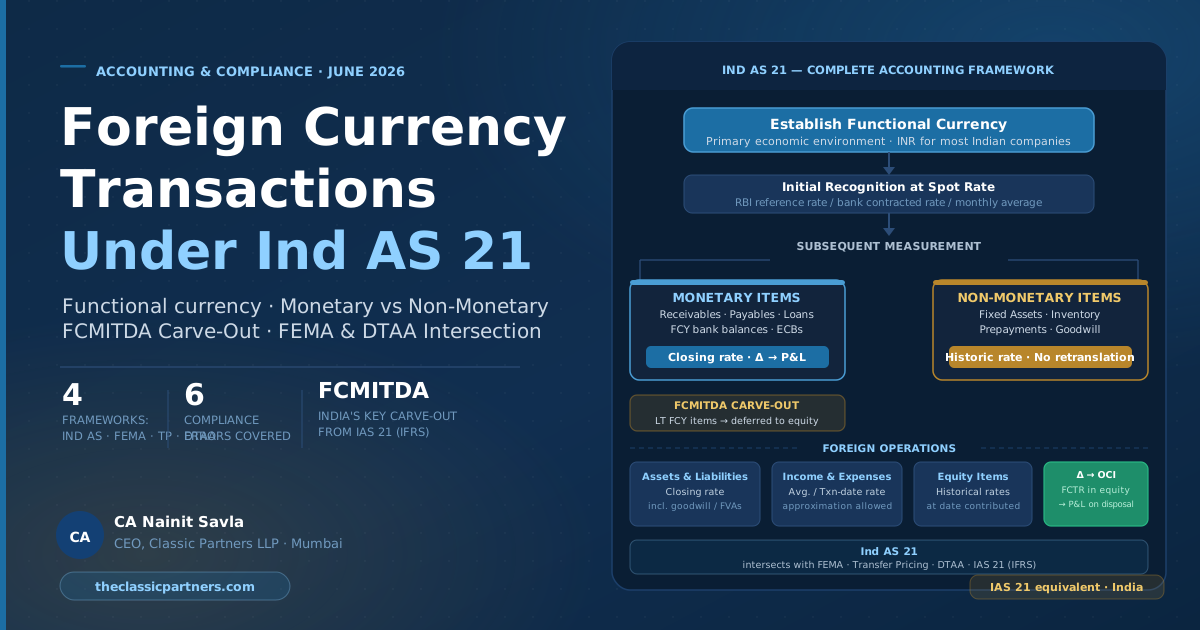
How to Account for Foreign Currency Transactions Under Ind AS 21 | Classic Partners LLP Home › Blog › Ind AS 21: Foreign Currency Transactions Accounting & Compliance · June 2026 How to Account for Foreign Currency Transactions Under Ind AS 21 Functional currency, monetary vs non-monetary items, the FCMITDA carve-out, translation of foreign operations — and the FEMA and DTAA intersection Indian CFOs need to understand. CA Nainit Savla CEO, Classic Partners LLP 25 June 2026 10 min read Standard Ind AS 21 · IAS 21 Equivalent Applies to all entities with imports · exports · foreign borrowings · overseas subsidiaries IND AS 21 — ACCOUNTING FLOW FUNCTIONAL CURRENCY INR for most Indian cos. MONETARY ITEMS Closing rate · Δ → P&L (or FCMITDA if LT) NON-MONETARY Historic rate · No retranslation Initial Recognition Spot rate (RBI ref rate / bank rate) Exchange Diff. → Profit or Loss Foreign Ops. Translation → OCI (FCTR in equity) 21 FCMITDA carve-out: long-term monetary items → deferred to equity reserve For any Indian business that imports raw materials, exports products or services, borrows in foreign currency, holds overseas investments, or has a foreign subsidiary, Ind AS 21 (The Effects of Changes in Foreign Exchange Rates) is the accounting standard that governs how every one of those transactions appears in the financial statements. Getting foreign currency accounting under Ind AS 21 right is not merely a technical compliance matter — it directly affects reported profit or loss, net worth, and the figures that banks, investors, and regulators rely on. Classic Partners LLP works extensively with Indian companies that have cross-border operations — from businesses with export receivables in USD to Indian subsidiaries of multinational groups consolidating under IFRS. In our experience, Ind AS 21 is one of the standards most commonly misapplied in practice, particularly in three areas: the classification of items as monetary or non-monetary, the FCMITDA carve-out for long-term borrowings, and the translation of foreign subsidiary financial statements. This guide addresses all three, with practical examples and the regulatory context CFOs and finance teams in India need. What this guide covers — at a glance Functional currency is determined by economic substance, not place of registration — and must be documented. Monetary items (receivables, payables, loans) are retranslated at closing rate; non-monetary items (fixed assets, inventory) are never retranslated. The FCMITDA carve-out — unique to Ind AS 21 vs IAS 21 — allows P&L smoothing for long-term foreign currency borrowings recognised before Ind AS adoption. Foreign subsidiary translation differences go to OCI (FCTR) — not P&L — until the operation is disposed of. Ind AS 21 interacts directly with FEMA compliance, transfer pricing documentation, and DTAA analysis — all three frameworks apply simultaneously for cross-border operations. 01The Foundation: Functional Currency Under Ind AS 21 Before accounting for a single foreign currency transaction, Ind AS 21 requires the entity to establish its functional currency — the currency of the primary economic environment in which it operates. This is not necessarily the same as the currency in which the entity prepares its books or the currency mandated by its country of registration. It is the currency that most fundamentally drives the economics of the business. Ind AS 21 sets out a hierarchy of indicators: Primary indicators (carry the most weight): the currency that mainly influences sales prices, and the currency of the country whose competitive forces and regulations mainly determine those prices Secondary indicators: the currency in which sales proceeds are retained, in which financing is raised, and in which operating receipts are normally held For the vast majority of Indian businesses — companies selling and operating in India with INR-denominated revenues and costs — the functional currency is the Indian Rupee (INR). Every transaction in any other currency is therefore a foreign currency transaction requiring Ind AS 21 treatment. When functional currency is genuinely complex The functional currency question becomes complex for: export-driven businesses where revenues are predominantly in USD or EUR; Indian subsidiaries of foreign multinationals where pricing, key management, and capital allocation are driven from the foreign parent’s currency environment; and companies in internationally benchmarked sectors such as aviation, shipping, and oil and gas where commodity prices are globally determined in USD. A change in functional currency is treated prospectively from the date of change — not retrospectively. The determination must be documented carefully, particularly for companies engaged in international tax planning where functional currency affects how cross-border income and costs are characterised. 02Initial Recognition of Foreign Currency Transactions A foreign currency transaction is any transaction denominated or requiring settlement in a foreign currency — purchases or sales of goods and services priced in foreign currency, borrowing or lending in foreign currency, acquisition of foreign assets, and subscriptions to foreign equity. At the date of the transaction, Ind AS 21 requires recognition at the spot exchange rate — the rate for immediate settlement on that specific date. In practice, Indian companies use: The RBI reference rate published daily on the RBI website The bank’s contracted rate for the specific transaction (for import LCs, export bills, or loan drawdowns) A weekly or monthly average rate as an approximation, provided exchange rates during that period did not fluctuate significantly The transaction is recorded in INR at this rate — no parallel entry in foreign currency is maintained in the Indian statutory books. The foreign currency amount is retained for tracking purposes for subsequent retranslation. Worked Example Import Purchase in EUR A Mumbai-based manufacturer imports machinery from Germany. Invoice: EUR 2,00,000, dated 15 June 2026. EUR/INR rate on 15 June: 92.50. Initial recognition: Fixed asset = EUR 2,00,000 × 92.50 = INR 1,85,00,000 Trade payable to German supplier = INR 1,85,00,000 ✔ The fixed asset is locked at INR 1,85,00,000 regardless of subsequent EUR/INR movements (non-monetary). The trade payable will be retranslated at each balance sheet date until settled (monetary). Worked Example Export Sale in USD with Settlement A Pune-based IT company invoices a US client USD 1,50,000 on 1 July 2026.

Uncategorized

IFRS vs US GAAP: Key Differences Every Business and Finance Professional Must Know

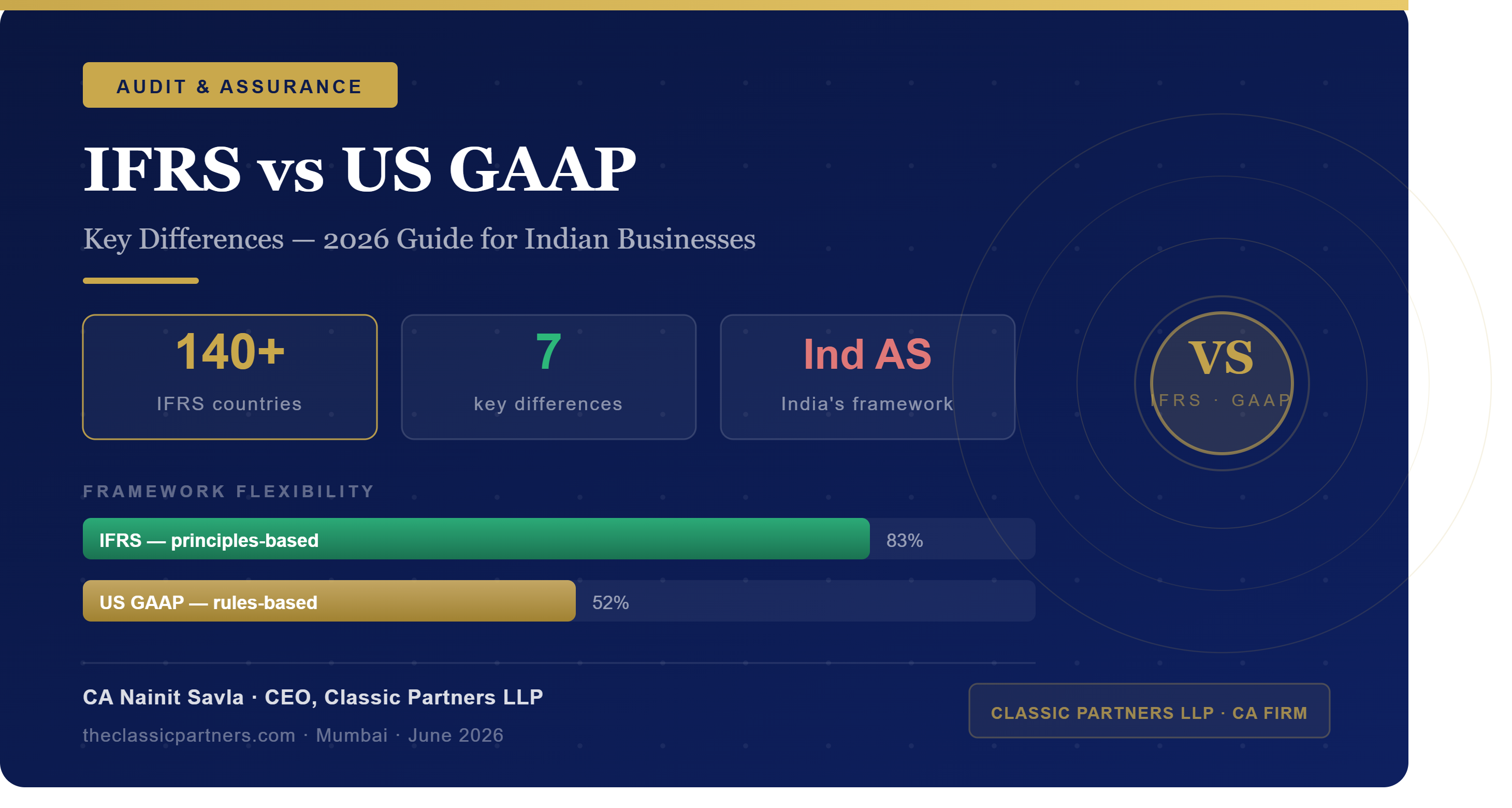
140+ COUNTRIES AUDIT & ASSURANCE IFRS vs US GAAP Key Differences — 2026 Comparison Guide 140+ IFRS Countries 7 Key Differences Ind AS India’s Framework FRAMEWORK FLEXIBILITY INDEX IFRS — Principles-Based 84% US GAAP — Rules-Based 52% CA Nainit Savla · CEO, Classic Partners LLP theclassicpartners.com · Mumbai · June 2026 VS IFRS · GAAP CLASSIC PARTNERS LLP · CHARTERED ACCOUNTANTS Two sets of accounting standards dominate global financial reporting — IFRS (International Financial Reporting Standards), applied across more than 140 countries, and US GAAP (Generally Accepted Accounting Principles), the mandatory framework for companies listed on US exchanges. For Indian companies with foreign investors, US subsidiaries, or cross-border financing, understanding the key IFRS vs US GAAP differences directly affects how financial statements are prepared, how profits are reported, and how comparable those numbers are to international peers. While India has converged its own standards (Ind AS) with IFRS, a growing number of Indian businesses interact with US GAAP through US parent companies, SEC filings, or American investors who benchmark against US GAAP reporting. The Foundational Difference: Principles vs Rules IASB (IFRS) vs FASB (US GAAP) — two accounting philosophies The most structurally important distinction in the IFRS vs US GAAP comparison is not a specific standard — it is the underlying philosophy of each framework. IFRS — Principles-Based Set by the IASB Broad conceptual objectives Professional judgment required Conceptual framework fills gaps Applied in 140+ countries US GAAP — Rules-Based Set by the FASB Prescriptive, detailed guidance Less room for judgment ASC runs to thousands of pages Mandatory for US exchange listings This philosophical difference explains many of the specific IFRS vs US GAAP differences that follow. Under IFRS, companies may reach different accounting conclusions based on management judgment. Under US GAAP, the rule specifies the outcome. Key IFRS vs US GAAP Differences: The Issues That Matter Most 1. Inventory Valuation — The LIFO Prohibition IFRS (IAS 2) explicitly prohibits LIFO (Last In, First Out). Companies must use FIFO or weighted average cost. US GAAP (ASC 330) permits LIFO in addition to FIFO and weighted average. For US companies with rising input costs — oil and gas, manufacturing, retail — LIFO can significantly reduce reported taxable income. For an Indian subsidiary of a US multinational, this requires a LIFO-to-FIFO adjustment in the reconciliation. 2. Development Costs — Capitalisation vs Expensing Under IFRS (IAS 38), development phase expenditure must be capitalised once six specific criteria are met — including technical feasibility, intention to complete, and ability to use or sell the asset. US GAAP (ASC 730) takes a more conservative position: R&D costs are generally expensed as incurred. A technology or pharmaceutical company under IFRS will typically show higher net assets than an otherwise identical company under US GAAP. 3. Asset Revaluation — Fair Value vs Cost Only IFRS (IAS 16) gives companies a choice: the cost model or the revaluation model (fair value less subsequent depreciation), where increases in fair value are recognised in OCI. US GAAP (ASC 360) permits only the cost model — upward revaluation is not permitted under any circumstances. For real estate companies and infrastructure operators, IFRS net worth may be substantially higher than the equivalent US GAAP figure. 4. Lease Accounting — Single Model vs Dual Model Both IFRS 16 and ASC 842 bring most leases onto the balance sheet. The key difference is income statement treatment. IFRS 16 uses a single model — all leases treated as finance leases with front-loaded interest and depreciation. ASC 842 retains a dual model — operating leases recognise a straight-line expense with no front-loading. This produces different EBITDA figures for the same lease, directly affecting financial covenant calculations in loan agreements. 5. Revenue Recognition — IFRS 15 vs ASC 606 Both IFRS 15 and ASC 606 adopt the same five-step model: identify the contract → identify performance obligations → determine the transaction price → allocate it → recognise as each obligation is satisfied. Despite convergence, differences remain in IP licences, principal vs agent assessments, and variable consideration constraints. For complex multi-element or long-term construction contracts, specialist advice is warranted. 6. Impairment of Assets — Reversibility Under IFRS (IAS 36), impairment losses (other than goodwill) can be reversed if circumstances improve. Under US GAAP (ASC 360 / ASC 350), impairment losses are not reversible for any asset category — once recognised, they cannot be unwound even if the asset subsequently recovers in value. 7. Contingent Liabilities — Different Probability Thresholds Under IFRS (IAS 37), a provision must be recognised when an outflow is probable (>50%). Under US GAAP (ASC 450), the practical bar is approximately 75–80% likelihood. The same legal dispute may be recognised as a provision on an IFRS balance sheet but disclosed only in the notes under US GAAP. IFRS vs US GAAP: Side-by-Side Comparison Area IFRS US GAAP Framework Type Principles-based (IASB) Rules-based (FASB) Inventory — LIFO Prohibited — IAS 2 Permitted — ASC 330 Development Costs Capitalised when IAS 38 criteria met Generally expensed as incurred Asset Revaluation Allowed — cost or revaluation model Not permitted — cost model only Lease — Income Statement Single model — all leases finance-type Dual model — finance vs operating Revenue Recognition IFRS 15 — 5-step model ASC 606 — same 5-step (minor differences) Impairment Reversal Allowed for non-goodwill assets Not permitted for any asset Contingent Liabilities Probable = more likely than not (>50%) Probable ≈ 75–80% in practice Investment Property Cost or fair value model — IAS 40 Cost model only — ASC 360 Biological Assets Fair value model — IAS 41 No specific standard What IFRS vs US GAAP Means for Indian Businesses For most Indian companies, the primary reporting framework is Ind AS. Understanding IFRS vs US GAAP differences becomes practically significant in these situations: Indian subsidiaries of US multinationals: Must provide US GAAP-adjusted data for group consolidation. Key reconciling items include development cost adjustments, LIFO-to-FIFO inventory adjustments, and lease income statement reclassification. Indian companies seeking US listings: A foreign private issuer can file under

Uncategorized

5 GST Filing Mistakes Small Businesses Commonly Make in India (And How to Avoid Them)

5 GST Filing Mistakes Small Businesses Commonly Make in India (And How to Avoid Them)For many small businesses, GST filing becomes stressful not because they avoid compliance, but because a single mistake can lead to blocked ITC, mismatch notices, or penalties. GST is detail-oriented, time-sensitive, and requires clean records. When things aren’t updated regularly, issues pile up.Strong processes, timely reconciliation, and expert guidance from a company tax consultant or reliable GST filing services in Mumbai can keep these problems away. Let’s walk through the most frequent GST mistakes and how small businesses can avoid them. If long-term stability is your goal, these are the areas to pay attention to—especially if you’re looking for the best CA for GST filing or want smooth GST compliance for small businesses. FAQ1) How often should a small business reconcile GST data?Ideally every month. Regular reconciliation prevents mismatches and avoids notices. Many businesses follow this with the help of the best CA for GST filing or dependable GST filing services in Mumbai to keep their books accurate.2) What documents should be kept for GST compliance?Maintain all invoices, purchase bills, debit and credit notes, bank statements, and e-way bills. Keeping digital copies helps maintain strong GST compliance for small businesses.3) Should small businesses hire a company tax consultant for GST filing?If you struggle with deadlines, mismatches, or ITC issues, a company tax consultant can save you time and prevent errors. It’s especially useful when you’re scaling.4) What happens if I miss my GST filing deadline?You may face late fees, interest charges, and even restrictions on e-way bill generation. Many businesses avoid this by working with professional GST filing services in Mumbai that monitor compliance dates.5) How do I know if my HSN/SAC codes are correct?You can verify codes using the official GST rate finder. If you want accuracy month after month, consulting the best CA for GST filing helps ensure your invoicing is compliant and error-free. Final ThoughtsGST doesn’t have to be complicated. When reconciliations are done monthly, invoices are accurate, deadlines are met, and records are organized, compliance becomes predictable instead of stressful. Whether you file in-house or work with experts, the goal is simple: clean data, timely filing, and fewer surprises.If you want reliable, long-term support, choosing the best CA for GST filing or engaging professional GST filing services in Mumbai can save time, avoid penalties, and build stronger compliance habits. And if you prefer structured, ongoing guidance, firms like The Classic Partners LLP help small businesses maintain high-quality, consistent GST compliance for small businesses without operational burden. Classic Partners LLPChartered Accountant | Incorporation • Compliance • Advisory📞 +91 98190 00445🌐 www.theclassicphttp://theclassicpartner.comartners.com

Uncategorized

Emotional Intelligence in Accounting: The Missing Link Between Data and Trust

Emotional Intelligence in Accounting: The Missing Link Between Data and Trust Walk into any accounting firm today, and you’ll see screens filled with numbers, dashboards, and compliance checklists. The profession has never been more data-driven. Yet, here’s the paradox — despite all this precision, what truly builds trust between a client and their accountant isn’t data. It’s emotional intelligence. Why Numbers Alone Aren’t Enough Accounting has always been about accuracy — reconciling, verifying, and reporting. But accuracy alone doesn’t win loyalty. Clients don’t just want reports; they want reassurance. They want to know their CA understands their fears, ambitions, and blind spots. That’s where c changes everything. Think about it. When a founder is anxious about a tax notice, or a family business is worried about cash flow, they’re not just looking for a technical answer — they’re looking for calm, confidence, and empathy. Emotional intelligence bridges that gap. It turns transactions into relationships, and relationships into trust. The Evolution of the Modern Accountant Once upon a time, accounting was a back-office job. You prepared statements, filed returns, and spoke through emails. Now, clients expect guidance, not just paperwork. They want their accountant to be part of decision-making — a strategic partner, not a service provider. In this new landscape, emotional intelligence in accounting isn’t a soft skill. It’s a competitive edge. Empathy helps a CA sense what a client isn’t saying.Self-awareness helps handle pressure during audits or assessments.Good communication turns complex financial jargon into clarity. The best accountants today don’t just deliver data; they deliver understanding. How Emotional Intelligence Improves Client Relationships Let’s break down how this skill actually plays out in real-world client interactions: Active Listening Builds ConfidenceWhen clients speak, they’re often revealing more than financial facts — they’re expressing uncertainty. A CA who listens beyond the numbers earns trust faster than one who just quotes tax sections. Empathy De-escalates Stressful SituationsTax scrutiny, GST notices, and compliance issues can cause panic. Responding with empathy (“Let’s handle this calmly — here’s the plan”) creates emotional safety and keeps the client anchored. Clarity Strengthens DecisionsExplaining things in a human way — not legalese — empowers clients. It helps them feel in control, even when the situation is complex. Consistency Builds LoyaltyClients remember how you made them feel, not just what you filed for them. Being patient, transparent, and responsive builds a reputation that spreadsheets can’t. The AI Revolution: Where Emotional Intelligence Still Wins Artificial Intelligence has entered accounting in full force — automating reconciliations, predicting cash flows, and flagging compliance gaps. But even with all that efficiency, one thing remains irreplaceable: human judgment and empathy. AI can process data. But only humans can understand emotion. That’s why emotional intelligence in accounting is now becoming the ultimate differentiator.A tech-savvy CA firm that pairs automation with human insight delivers the best of both worlds — precision and perspective. Clients no longer judge a firm only by how fast it files returns. They value how well it understands their unique situation. In other words, the heart is now as important as the head. Building Emotional Intelligence in Accounting Teams For firms, developing emotional intelligence isn’t about a motivational workshop — it’s about culture. Train for communication, not just compliance.Encourage teams to simplify explanations and build comfort in client interactions. Normalize empathy in client service.Ask, “What’s worrying the client right now?” as often as “What’s the due date?” Balance logic with intuition.Not every decision is on a spreadsheet. Some are built on trust and timing. Encourage reflection.Emotional intelligence grows when professionals pause to think — “How did I handle that conversation? Did I listen enough?” The accounting profession has traditionally prized technical mastery. But the next generation of leaders will be defined by their ability to combine intellect with empathy. Why Clients Gravitate Toward Emotionally Intelligent Firms Clients are becoming more selective. They want firms that make them feel safe, not just compliant.When you practice emotional intelligence, you: Build longer relationships Win more referrals Reduce client churn Handle conflicts more gracefully It’s not about being “nice.” It’s about being attuned. A financially sound client who trusts your guidance is your firm’s best brand ambassador. The Future of the Profession The future of accounting isn’t purely digital — it’s emotional.Technology will handle data. Humans will handle meaning. CAs who can combine the analytical precision of Excel with the emotional depth of human understanding will lead the profession forward. And firms that invest in empathy will naturally rise above those that only automate. At Classic Partners LLP, this belief shapes how we work.Yes, we use advanced tech and automation — but our real strength lies in how we listen, guide, and communicate. Because behind every number is a story. And that story deserves to be understood. FAQs 1. What is emotional intelligence in accounting? It’s the ability of accountants to understand and manage their own emotions — and their clients’ — while making financial decisions. It helps build trust, reduce stress, and improve collaboration. 3. Can AI replace emotional intelligence in accounting? No. AI can automate data entry and analysis, but emotional understanding, empathy, and ethical judgment are human strengths that technology can’t replicate. 5. Why is emotional intelligence becoming important for CAs in 2025? Because the profession is shifting from compliance to advisory. Clients expect emotional understanding, clear communication, and trusted guidance — not just calculations. 2. How does emotional intelligence help Chartered Accountants? It enhances client relationships, improves communication during complex situations, and helps handle pressure calmly — making accountants more effective and trusted advisors. 4. How can firms develop emotional intelligence in teams? Through training in communication, reflective practices, and creating a culture that values empathy as much as technical excellence.

Scroll to Top