

IFRS vs US GAAP: Key Differences Every Business and Finance Professional Must Know
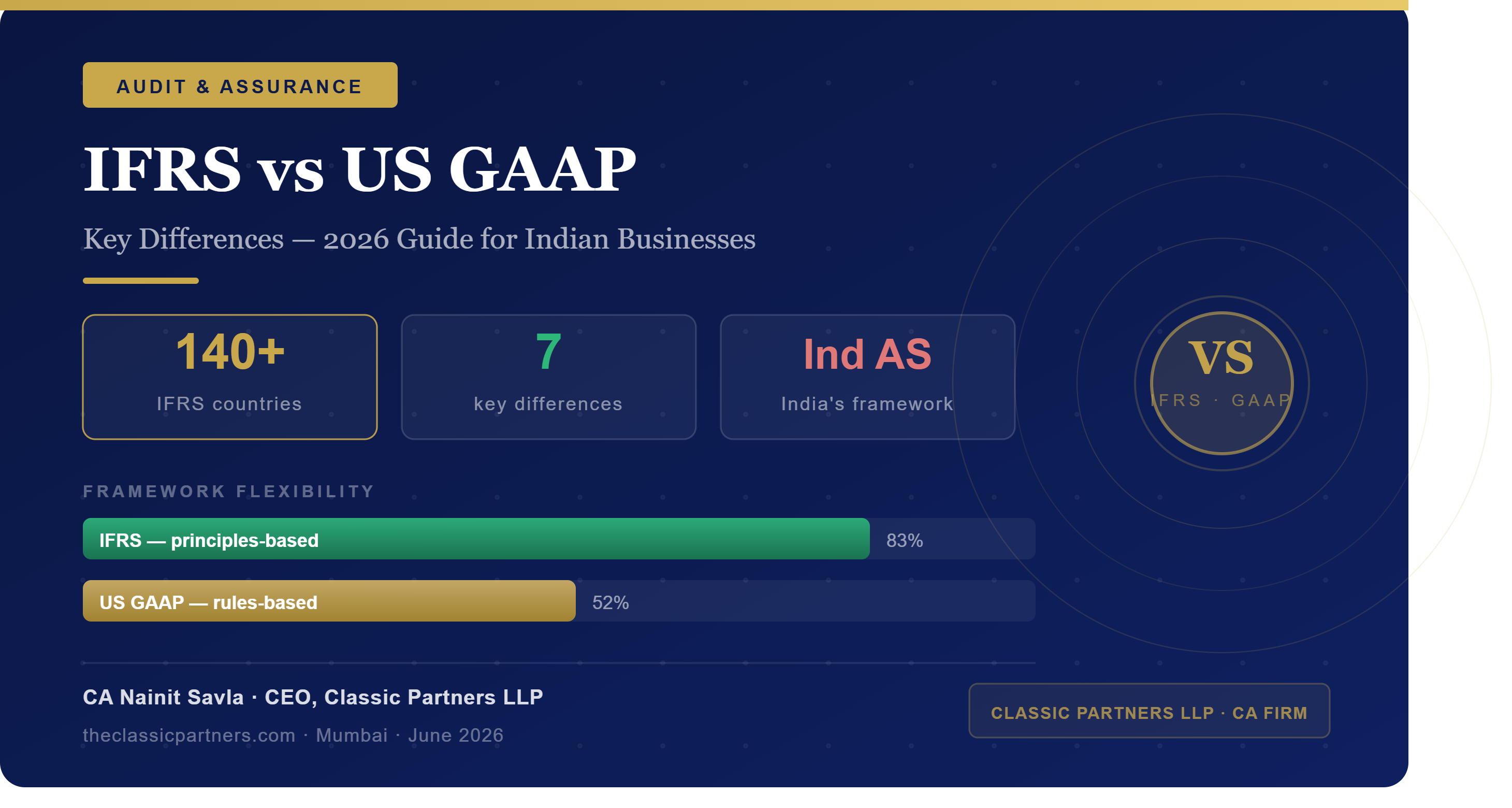
140+ COUNTRIES AUDIT & ASSURANCE IFRS vs US GAAP Key Differences — 2026 Comparison Guide 140+ IFRS Countries 7 Key Differences Ind AS India’s Framework FRAMEWORK FLEXIBILITY INDEX IFRS — Principles-Based 84% US GAAP — Rules-Based 52% CA Nainit Savla · CEO, Classic Partners LLP theclassicpartners.com · Mumbai · June 2026 VS IFRS · GAAP CLASSIC PARTNERS LLP · CHARTERED ACCOUNTANTS Two sets of accounting standards dominate global financial reporting — IFRS (International Financial Reporting Standards), applied across more than 140 countries, and US GAAP (Generally Accepted Accounting Principles), the mandatory framework for companies listed on US exchanges. For Indian companies with foreign investors, US subsidiaries, or cross-border financing, understanding the key IFRS vs US GAAP differences directly affects how financial statements are prepared, how profits are reported, and how comparable those numbers are to international peers. While India has converged its own standards (Ind AS) with IFRS, a growing number of Indian businesses interact with US GAAP through US parent companies, SEC filings, or American investors who benchmark against US GAAP reporting. The Foundational Difference: Principles vs Rules IASB (IFRS) vs FASB (US GAAP) — two accounting philosophies The most structurally important distinction in the IFRS vs US GAAP comparison is not a specific standard — it is the underlying philosophy of each framework. IFRS — Principles-Based Set by the IASB Broad conceptual objectives Professional judgment required Conceptual framework fills gaps Applied in 140+ countries US GAAP — Rules-Based Set by the FASB Prescriptive, detailed guidance Less room for judgment ASC runs to thousands of pages Mandatory for US exchange listings This philosophical difference explains many of the specific IFRS vs US GAAP differences that follow. Under IFRS, companies may reach different accounting conclusions based on management judgment. Under US GAAP, the rule specifies the outcome. Key IFRS vs US GAAP Differences: The Issues That Matter Most 1. Inventory Valuation — The LIFO Prohibition IFRS (IAS 2) explicitly prohibits LIFO (Last In, First Out). Companies must use FIFO or weighted average cost. US GAAP (ASC 330) permits LIFO in addition to FIFO and weighted average. For US companies with rising input costs — oil and gas, manufacturing, retail — LIFO can significantly reduce reported taxable income. For an Indian subsidiary of a US multinational, this requires a LIFO-to-FIFO adjustment in the reconciliation. 2. Development Costs — Capitalisation vs Expensing Under IFRS (IAS 38), development phase expenditure must be capitalised once six specific criteria are met — including technical feasibility, intention to complete, and ability to use or sell the asset. US GAAP (ASC 730) takes a more conservative position: R&D costs are generally expensed as incurred. A technology or pharmaceutical company under IFRS will typically show higher net assets than an otherwise identical company under US GAAP. 3. Asset Revaluation — Fair Value vs Cost Only IFRS (IAS 16) gives companies a choice: the cost model or the revaluation model (fair value less subsequent depreciation), where increases in fair value are recognised in OCI. US GAAP (ASC 360) permits only the cost model — upward revaluation is not permitted under any circumstances. For real estate companies and infrastructure operators, IFRS net worth may be substantially higher than the equivalent US GAAP figure. 4. Lease Accounting — Single Model vs Dual Model Both IFRS 16 and ASC 842 bring most leases onto the balance sheet. The key difference is income statement treatment. IFRS 16 uses a single model — all leases treated as finance leases with front-loaded interest and depreciation. ASC 842 retains a dual model — operating leases recognise a straight-line expense with no front-loading. This produces different EBITDA figures for the same lease, directly affecting financial covenant calculations in loan agreements. 5. Revenue Recognition — IFRS 15 vs ASC 606 Both IFRS 15 and ASC 606 adopt the same five-step model: identify the contract → identify performance obligations → determine the transaction price → allocate it → recognise as each obligation is satisfied. Despite convergence, differences remain in IP licences, principal vs agent assessments, and variable consideration constraints. For complex multi-element or long-term construction contracts, specialist advice is warranted. 6. Impairment of Assets — Reversibility Under IFRS (IAS 36), impairment losses (other than goodwill) can be reversed if circumstances improve. Under US GAAP (ASC 360 / ASC 350), impairment losses are not reversible for any asset category — once recognised, they cannot be unwound even if the asset subsequently recovers in value. 7. Contingent Liabilities — Different Probability Thresholds Under IFRS (IAS 37), a provision must be recognised when an outflow is probable (>50%). Under US GAAP (ASC 450), the practical bar is approximately 75–80% likelihood. The same legal dispute may be recognised as a provision on an IFRS balance sheet but disclosed only in the notes under US GAAP. IFRS vs US GAAP: Side-by-Side Comparison Area IFRS US GAAP Framework Type Principles-based (IASB) Rules-based (FASB) Inventory — LIFO Prohibited — IAS 2 Permitted — ASC 330 Development Costs Capitalised when IAS 38 criteria met Generally expensed as incurred Asset Revaluation Allowed — cost or revaluation model Not permitted — cost model only Lease — Income Statement Single model — all leases finance-type Dual model — finance vs operating Revenue Recognition IFRS 15 — 5-step model ASC 606 — same 5-step (minor differences) Impairment Reversal Allowed for non-goodwill assets Not permitted for any asset Contingent Liabilities Probable = more likely than not (>50%) Probable ≈ 75–80% in practice Investment Property Cost or fair value model — IAS 40 Cost model only — ASC 360 Biological Assets Fair value model — IAS 41 No specific standard What IFRS vs US GAAP Means for Indian Businesses For most Indian companies, the primary reporting framework is Ind AS. Understanding IFRS vs US GAAP differences becomes practically significant in these situations: Indian subsidiaries of US multinationals: Must provide US GAAP-adjusted data for group consolidation. Key reconciling items include development cost adjustments, LIFO-to-FIFO inventory adjustments, and lease income statement reclassification. Indian companies seeking US listings: A foreign private issuer can file under