A Section 43B(h) compliance checklist is the simplest way to make sure that every rupee you owe to a micro or small supplier is paid within the 15-day or 45-day limit under the MSMED Act, 2006, because any amount still unpaid beyond that limit on 31 March is disallowed as a business expense for the year. The deduction comes back only in the year you actually pay, which means an upfront tax cost and, very often, an awkward conversation with your tax auditor.
Section 43B(h) of the Income-tax Act, 1961 has now been through two full audit cycles, and FY 2025-26 is the last year it will be audited under that name. From 1 April 2026 the same rule sits in section 37(2)(g) of the Income-tax Act, 2025. The principle has not changed, but the stakes have grown, since the revised MSME limits now bring many more of your vendors into the micro and small categories. This guide from The Classic Partners LLP, Chartered Accountants in Andheri East, Mumbai, sets out what the rule requires, a step-by-step checklist your accounts team can follow, how to set up vendor tracking in your accounting system, and how the amounts are reported in the tax audit report.
What Is Section 43B(h) and Why Does It Matter?
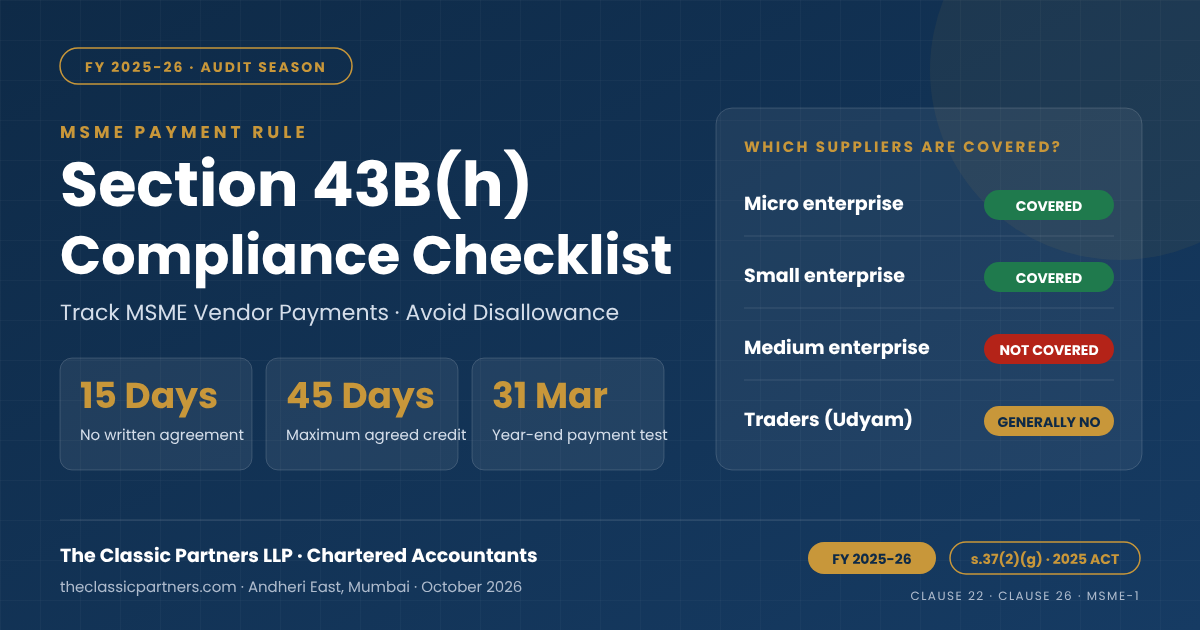
Section 43B(h) allows a deduction for any sum payable by you to a micro or small enterprise only in the year in which it is actually paid, if the payment is made after the time limit in section 15 of the MSMED Act. It was inserted by the Finance Act, 2023 and applies from FY 2023-24 onwards, with the aim of improving cash flow for small suppliers who were routinely paid late by larger buyers.
The rule differs from the rest of section 43B in one critical way. For items such as statutory dues or bonus, paying before the due date of the return saves the deduction. That relief is expressly not available for clause (h), so paying an overdue MSME invoice in April, May or July does not bring the deduction back into the earlier year.
| Element | What the law says |
|---|---|
| Who is affected | Any buyer (company, LLP, firm, proprietor) that claims the purchase or service cost as a business expense, regardless of the buyer's own size |
| Which suppliers | Micro and small enterprises under the MSMED Act; medium enterprises are not covered |
| Time limit | 15 days from acceptance or deemed acceptance if there is no written agreement; the agreed period if there is one, but never more than 45 days |
| Test date | 31 March of the financial year; amounts overdue and unpaid on that date are disallowed |
| When allowed | In the year of actual payment |
| Return due date relief | Not available for clause (h) |
| New Act reference | Section 37(2)(g), read with section 37(3), of the Income-tax Act, 2025 from FY 2026-27 |
Which Suppliers Count as Micro or Small Enterprises?
Classification depends on the supplier's investment in plant, machinery or equipment and its turnover. The limits were raised with effect from 1 April 2025 by notification S.O. 1364(E), so many vendors that were medium enterprises earlier are now small, and some small ones are now micro. Re-check your vendor master against the current Udyam certificates.
| Category | Investment in plant, machinery or equipment | Turnover | 43B(h) applies? |
|---|---|---|---|
| Micro | Up to ₹2.5 crore | Up to ₹10 crore | Yes |
| Small | Up to ₹25 crore | Up to ₹100 crore | Yes |
| Medium | Up to ₹125 crore | Up to ₹500 crore | No |
Both conditions must be met for a category. Limits as revised from 1 April 2025.
Usually Covered
- Manufacturers and service providers with Udyam registration as micro or small
- Expenses claimed in the profit and loss account, such as raw material, job work, packing, repairs and professional services
- Payables of any amount, with no minimum threshold
Usually Outside the Rule
- Medium enterprises, even if Udyam registered
- Retail and wholesale traders, whose Udyam registration is generally limited to priority sector lending
- Capital purchases, where the cost is capitalised rather than claimed as an expense
- Buyers on presumptive taxation under section 44AD or 44ADA, who do not claim expenses separately
The position on traders is widely accepted but is not settled in the statute itself, so record the basis on which you treat a trader as outside the rule and keep the supplier's Udyam certificate on file. If your own business needs to register, see our guide on Udyam registration and MSME registration.
How Do the 15-Day and 45-Day Payment Limits Work?
The clock starts on the day of acceptance of the goods or services, or the day of deemed acceptance, which is generally the 15th day after delivery if the buyer raises no written objection. From that day, you have 15 days to pay if there is no written agreement, and up to 45 days if a written agreement allows it. A contract that grants 60 or 90 days of credit does not extend the limit beyond 45 days.
| Situation | Payment due within | Practical point |
|---|---|---|
| No written agreement | 15 days of acceptance | Purchase orders and invoices alone may not be treated as an agreement on credit terms |
| Written agreement with 30 days | 30 days of acceptance | The agreed period applies as it is within 45 days |
| Written agreement with 60 or 90 days | 45 days of acceptance | The excess credit period is not recognised |
| Goods rejected in writing within 15 days | Clock starts after defects are removed and goods accepted | Keep dated rejection and re-acceptance records |
Worked Example: What Gets Disallowed for FY 2025-26?
Assume a private limited company buys packaging from a Udyam-registered micro manufacturer under a written agreement allowing 45 days of credit. Three invoices are open during the last quarter of FY 2025-26.
| Invoice | Accepted on | Due by (45 days) | Paid on | FY 2025-26 result |
|---|---|---|---|---|
| A — ₹6,00,000 | 10 Jan 2026 | 24 Feb 2026 | 20 Feb 2026 | Allowed — paid on time |
| B — ₹4,00,000 | 5 Feb 2026 | 22 Mar 2026 | 15 Apr 2026 | Disallowed — overdue and unpaid on 31 March; allowed in FY 2026-27 |
| C — ₹5,00,000 | 1 Mar 2026 | 15 Apr 2026 | 10 Apr 2026 | Allowed — paid within the limit, even though after year-end |
Only invoice B is disallowed. Invoice C shows a point that many teams miss: an amount that is not yet due on 31 March and is then paid within its time limit is not hit by the rule. At the effective rate of about 25.17 percent under section 115BAA, the ₹4 lakh disallowance on invoice B costs the company roughly ₹1 lakh of tax a year earlier than expected. Multiply that across hundreds of vendors and the cash impact is significant.
⚠️ Important: Had invoice C been paid on 20 April 2026, after its due date of 15 April, it too would have been disallowed for FY 2025-26, even though it was not overdue on 31 March. The test is whether payment was made within the section 15 limit, so the ageing report must look forward past year-end, not only backward.
The Section 43B(h) Compliance Checklist: Step by Step
The checklist below follows the life of a vendor relationship, from onboarding to the tax audit. Each phase lists what your accounts or procurement team should do, so that no MSME payable slips past its due date unnoticed.
Vendor Onboarding and Classification
At onboarding- Collect the Udyam registration certificate, or a signed declaration that the vendor is not registered, from every new supplier.
- Verify the Udyam number on the official Udyam registration portal and note the category: micro, small or medium.
- Record whether the vendor is a manufacturer, a service provider or a trader, since traders are generally outside the rule.
- Note the date of registration, as dues from before a vendor registered are generally not covered.
- Repeat the exercise for existing vendors at least once a year, preferably in April, because classification can change with turnover and the revised limits.
Contracts and Credit Terms
Before the first order- Put a written agreement in place with each micro and small vendor where you need more than 15 days of credit.
- Cap credit terms at 45 days in the agreement, purchase order terms and vendor master.
- Define what counts as acceptance, such as the goods receipt note date or service completion certificate, and how rejections must be raised.
- Agree that the vendor will inform you within a set time of any change in Udyam status.
Day-to-Day Tracking
Weekly- Capture the acceptance date for every MSME invoice, not only the invoice date, and let the system calculate the due date.
- Run an MSME ageing report by due date every week and share it with the person who approves payment runs.
- Give MSME invoices priority in each payment run, especially those due within the next seven days.
- Log written rejections and disputes with dates, so that the clock can be reset only where the law allows.
- Match advances and debit notes against open invoices, so the ageing shows the true amount outstanding.
Year-End Review
15 to 31 March- Pull a list of every MSME payable open in the last fortnight of March and clear all overdue amounts by 31 March.
- Flag invoices accepted in February and March that will fall due in April or May, and plan their payment within the limit.
- Obtain balance confirmations from major micro and small vendors.
- Prepare a schedule of amounts disallowed for the year and a separate schedule of earlier years' disallowances paid in this year, which become deductible now.
Tax Audit, Return and ROC Reporting
After year-end- Share the 43B(h) schedule with your tax auditor for reporting in clause 22 and clause 26 of Form 3CD.
- Add back the disallowance in the computation of income and claim earlier years' amounts paid during the year.
- Calculate interest payable to MSMEs under section 16 of the MSMED Act on delayed payments, and treat it as not deductible.
- Disclose MSME dues and interest in the notes to the financial statements as required under the MSMED Act and Schedule III.
- For companies, file MSME Form 1 with the Registrar for dues outstanding beyond 45 days, every half-year.
If your team does not have the bandwidth to run these steps every week, our virtual CFO services and outsourced bookkeeping teams can build the tracker and run the weekly review for you.
How Should You Set Up MSME Vendor Tracking in Your Accounting System?
The simplest approach is to add a small number of fields to your vendor master and purchase entries, whether you use Tally, Zoho Books, SAP, Busy or another system, and to build one report that sorts MSME payables by due date. Once the data is captured at source, the year-end schedule and the tax audit reporting take minutes rather than days.
| Field | Where to capture it | Why it matters |
|---|---|---|
| MSME flag and category (micro, small, medium, not registered) | Vendor master | Filters the vendors to which the rule applies |
| Udyam number and registration date | Vendor master | Evidence for the auditor and for any later assessment |
| Nature of activity (manufacturer, service, trader) | Vendor master | Supports the treatment of traders |
| Agreed credit days (maximum 45) | Vendor master and purchase order | Drives the due date calculation |
| Acceptance or deemed acceptance date | Purchase or goods receipt entry | Starts the section 15 clock |
| Calculated due date | Purchase entry (formula) | Feeds the ageing report and payment priority |
| Payment date | Payment voucher | Confirms whether the deduction is allowed and in which year |
📋 Note: Many accounting systems use the invoice date as the default for due dates. For 43B(h), the relevant date is acceptance, which can be later than the invoice date when goods arrive after the bill. If you cannot capture acceptance, using the invoice date is the cautious option, as it can only make a due date earlier. Our accounting review services can check how your system calculates these dates.
How Is Section 43B(h) Reported in the Tax Audit Report?
MSME payments are reported in two places in Form 3CD. Clause 22 deals with the MSMED Act and asks for the amount of interest that is not deductible under section 23 of that Act, along with the amounts payable to micro and small enterprises and whether they were paid within the section 15 limit. Clause 26 covers section 43B as a whole and includes the sums falling under clause (h). The two clauses should be reconciled with each other and with the notes to accounts before the report is signed.
For FY 2025-26, the CBDT extended the due date for the tax audit report to 21 October 2026 and the due date for returns of audit cases to 21 November 2026, according to reports of its September 2026 announcement. If your audit report has already been filed, make sure the disallowance it reports is added back in your business tax return, because a mismatch between the audit report and the return is a common trigger for an adjustment. Read more on our tax audit under the Income Tax Act page, and our earlier article on the new ITR forms for AY 2026-27.
| Reporting point | What to report | Timing for FY 2025-26 |
|---|---|---|
| Form 3CD, clause 22 | MSMED Act interest not deductible; amounts payable to micro and small enterprises and whether paid within the section 15 limit | With the tax audit report, due 21 October 2026 after extension |
| Form 3CD, clause 26 | Section 43B sums, including clause (h), paid or unpaid | Same as above |
| Income tax return | Add-back of the disallowance; claim of earlier years' amounts paid this year | 21 November 2026 for audit cases after extension |
| MSME Form 1 (companies) | Dues to micro and small suppliers outstanding beyond 45 days | Half-yearly: 31 October for April to September, 30 April for October to March |
| Financial statements | MSME dues, interest paid and payable | With the audited accounts |
⚠️ Important: MSME Form 1 for the half-year April to September 2026 is due on 31 October 2026. Companies with any micro or small vendor dues outstanding for more than 45 days should file it in time. Our ROC filing team can help, and you can confirm the current due date on the MCA portal.
From FY 2026-27, tax audits will be reported under the Income-tax Act, 2025, and reports indicate that a single new form will replace Forms 3CA, 3CB and 3CD. The MSME disclosures are expected to continue in substance, so the tracking you set up now will carry forward.
What Changes for MSME Payments Under the Income-tax Act, 2025?
The rule continues without a change in substance. Under the Income-tax Act, 2025, which applies from 1 April 2026, the disallowance for late payments to micro and small enterprises sits in section 37(2)(g), and section 37(3) keeps it outside the relief for payments made before the return due date. A Rajya Sabha reply in July 2026 confirmed this correspondence and that the payment timeline cannot exceed 45 days.
- FY 2025-26 and earlier. Cite section 43B(h) of the Income-tax Act, 1961 in your audit report, return and any correspondence.
- FY 2026-27 onwards. Cite section 37(2)(g) of the Income-tax Act, 2025. Note that this is not the old general business-expense section 37 of the 1961 Act.
- Carry-over amounts. Amounts disallowed for FY 2025-26 and paid in FY 2026-27 are claimed in FY 2026-27, the year of payment. Keep the earlier year's schedule ready, so the claim is easy to support.
For an overview of the transition to the new law and the new forms, see our page on new income tax forms for 2026. The bare text of both Acts is available on the Income Tax Department portal.
What Interest Is Payable to MSMEs on Delayed Payments?
Apart from the tax disallowance, a buyer who pays a micro or small supplier late is liable under section 16 of the MSMED Act to pay compound interest with monthly rests at three times the bank rate notified by the Reserve Bank of India, from the appointed day until payment. Under section 23 of the same Act, this interest is not deductible for income tax purposes, so late payment carries two separate costs.
Suppliers can recover unpaid dues and interest through the MSME Facilitation Council, and many now file claims online through the MSME Samadhaan portal. Councils may also refer the matter to conciliation or arbitration, which adds legal costs and management time to an otherwise routine payable.
🚫 Avoid: Asking suppliers to give up their Udyam registration or moving purchases to unregistered vendors only to avoid the rule. Apart from the commercial risk, it does not change the position for dues already incurred, and it can attract scrutiny if the department examines your vendor pattern.
Common Mistakes That Lead to a Section 43B(h) Disallowance
Most disallowances come from process gaps rather than a lack of funds. The mistakes below are the ones we see most often while reviewing accounts and tax audit schedules.
- Relying on 60 or 90-day contracts. Credit terms longer than 45 days are not recognised, even when the supplier has agreed to them in writing.
- Assuming no agreement means 45 days. Without a written agreement the limit is 15 days, which catches many routine purchases.
- Paying overdue amounts in April. Payment before the return due date does not save the deduction for clause (h).
- Using an old vendor master. The revised limits from 1 April 2025 changed many classifications, and vendors registered during the year are often not flagged.
- Ignoring post year-end due dates. Invoices due in April or May must still be paid on time, or they are disallowed for the earlier year.
- Forgetting the reverse entry. Amounts disallowed last year and paid this year are deductible now, and are often not claimed.
- Mismatched reporting. Figures in clause 22, clause 26, the notes to accounts and the return that do not agree with each other invite questions in a scrutiny assessment.
If you have already received a notice or an adjustment on this issue, our team handles notice replies and assessment support, including responses to section 143(1)(a) adjustments, and a tax health check can find similar gaps before the department does.
How Has the MSME Payment Rule Developed Over the Years?
The obligation to pay small suppliers on time has existed for almost two decades, but it gained real force only when the income tax deduction was linked to it in 2023.
- 2006. The MSMED Act sets the 15-day and 45-day payment limits, compound interest at three times the bank rate, and non-deductibility of that interest under section 23.
- 2019. Companies are required to file MSME Form 1 with the Registrar, reporting dues to micro and small enterprises outstanding beyond 45 days.
- July 2021. Retail and wholesale traders are allowed Udyam registration, with benefits generally limited to priority sector lending.
- 1 April 2023. Section 43B(h) is inserted by the Finance Act, 2023, linking the tax deduction to the payment limits from FY 2023-24.
- 1 April 2025. MSME classification limits are raised, bringing more vendors into the micro and small categories.
- 1 April 2026. The Income-tax Act, 2025 takes effect and the rule continues as section 37(2)(g). FY 2025-26 is the last year audited under section 43B(h).
Need Help With Section 43B(h) Compliance?
Setting up MSME vendor tracking, preparing the year-end disallowance schedule and reporting it correctly in the tax audit report takes care, especially for businesses with hundreds of suppliers. The Classic Partners LLP, a Chartered Accountant firm based in Andheri East, Mumbai, helps businesses build the tracker, review payables before 31 March and handle the audit and return through our tax audit and virtual CFO practices.
Phone: +91 98190 00445 · +91 98190 00511 · Email: info@theclassicpartners.com
Frequently Asked Questions About Section 43B(h)
What is the 45-day rule under Section 43B(h)?
A buyer must pay a micro or small enterprise within the period agreed in writing, which cannot exceed 45 days from acceptance of the goods or services, or within 15 days if there is no written agreement. If the amount is still unpaid beyond that limit at the end of the financial year, the expense is disallowed for that year and allowed only in the year of payment.
Does Section 43B(h) apply to payments to medium enterprises or traders?
No for medium enterprises, as the rule covers only micro and small enterprises. Retail and wholesale traders can obtain Udyam registration, but their benefits are generally limited to priority sector lending, so the widely held view is that 43B(h) does not apply to purchases from them. Keep the supplier's Udyam certificate and record the basis of your treatment.
Can I claim the deduction if I pay the MSME after 31 March but before filing my return?
Only if the payment is within the 15-day or 45-day limit. If the amount was already overdue, paying it before the return due date does not help, because the relief available to other section 43B items is expressly excluded for clause (h). The deduction will be allowed in the year of payment instead.
How is a Section 43B(h) disallowance reported in the tax audit report?
It is reported in Form 3CD, in clause 22, which covers amounts payable to micro and small enterprises and interest under the MSMED Act, and in clause 26, which covers section 43B. The disallowance must then be added back in the income tax return, and the figures should agree with the notes to the financial statements.
What is the equivalent of Section 43B(h) in the Income-tax Act, 2025?
The equivalent is section 37(2)(g) of the Income-tax Act, 2025, read with section 37(3), which applies from 1 April 2026, that is, from FY 2026-27. Section 43B(h) of the 1961 Act continues to apply for FY 2025-26 and earlier years.
Does Section 43B(h) apply if my supplier is not registered on Udyam?
In practice, Udyam registration is the accepted evidence that a supplier is a micro or small enterprise, and dues relating to the period before registration are generally not covered. Obtain either the Udyam certificate or a written declaration of non-registration from every vendor, and update it when the vendor registers.
Is interest paid to an MSME for late payment tax-deductible?
No. Section 23 of the MSMED Act provides that interest payable under section 16 for delayed payment is not allowed as a deduction under the income tax law. It must be reported in clause 22 of Form 3CD and added back in the computation of income.
Who must file MSME Form 1, and when?
Companies whose payments to micro or small suppliers remain outstanding beyond 45 days must file MSME Form 1 with the Registrar of Companies every half-year: by 31 October for April to September, and by 30 April for October to March. LLPs, firms and proprietors are not required to file it, but the tax disallowance still applies to them.


